Compliance Vs. Resilience: What Your Board Needs to Know
Compliance is a snapshot; resilience is a capability. Security assessments are often treated as a "false finish line," but effective risk management is the true bridge. Learn the four questions boards should be askining.
- Risk management
- Compliance
- NIS2
- ISO 27001
- Board & governance
- Cyber Resilience Act
- Security assessment
The assessment is finished. Your team presented the report, documented the findings, and the maturity score came across well in the management meeting. There is a quiet sense in the room that the hard part is behind you.
It rarely is, because compliance is a state you can demonstrate while resilience is a capability you have to maintain. The first can be true in March and less true by June, without anyone on your team doing anything wrong and without a line of that report changing.
The false finish line
An assessment report is a photograph: accurate, admissible as evidence, and fixed at the moment the shutter closes, while everything inside the frame carries on changing.
Verizon has assessed organisations against the payment card security standard for more than a decade. Its 2024 report found no card data breach at an organisation that was fully compliant at the time. In each case the once compliant organisation had lapsed, and the distance between its security snapshot and the present had grown too far.
What an assessment gives you
An assessment gives you a view of where you are today, expressed so that someone outside your team can scrutinise it, and a list of weaknesses ranked by severity. If you have never set that baseline, finding out where you actually stand is the right first move.
The assessment then leaves four decisions with you: which of those weaknesses matter most to your organisation, who fixes them, which gaps you close and which you accept for now, and by when. It also has no trend in it. Direction needs a second photograph.
What happens next
Everything that turns a finding into an outcome happens after the assessment, and it comes down to four questions.
- Which of these matter most? Severity is a property of the weakness and priority is a property of your organisation, so the same misconfiguration means something different depending on what sits behind it.
- Who owns this? The owner is the person accountable for the outcome, and that is often someone other than the person who spotted the weakness or the engineer who will patch it. ISO 27001 treats identifying risk owners as part of the assessment itself. Whoever owns a business process owns the risks that live in it, so the list cannot all read CISO.
- What are we going to do about it? You can treat the risk, transfer it, avoid the activity that creates it, or accept it. Accepting is legitimate, provided someone with the authority to accept it has made that decision, and you still have to keep watching it, because a risk you decided to live with last year may be a different size this year.
- By when, and how will we know? ISO 27001 requires risk owners to approve the treatment plan and accept whatever risk remains, which only means something if the plan has dates attached and somebody checks them.
Risk management is the missing bridge
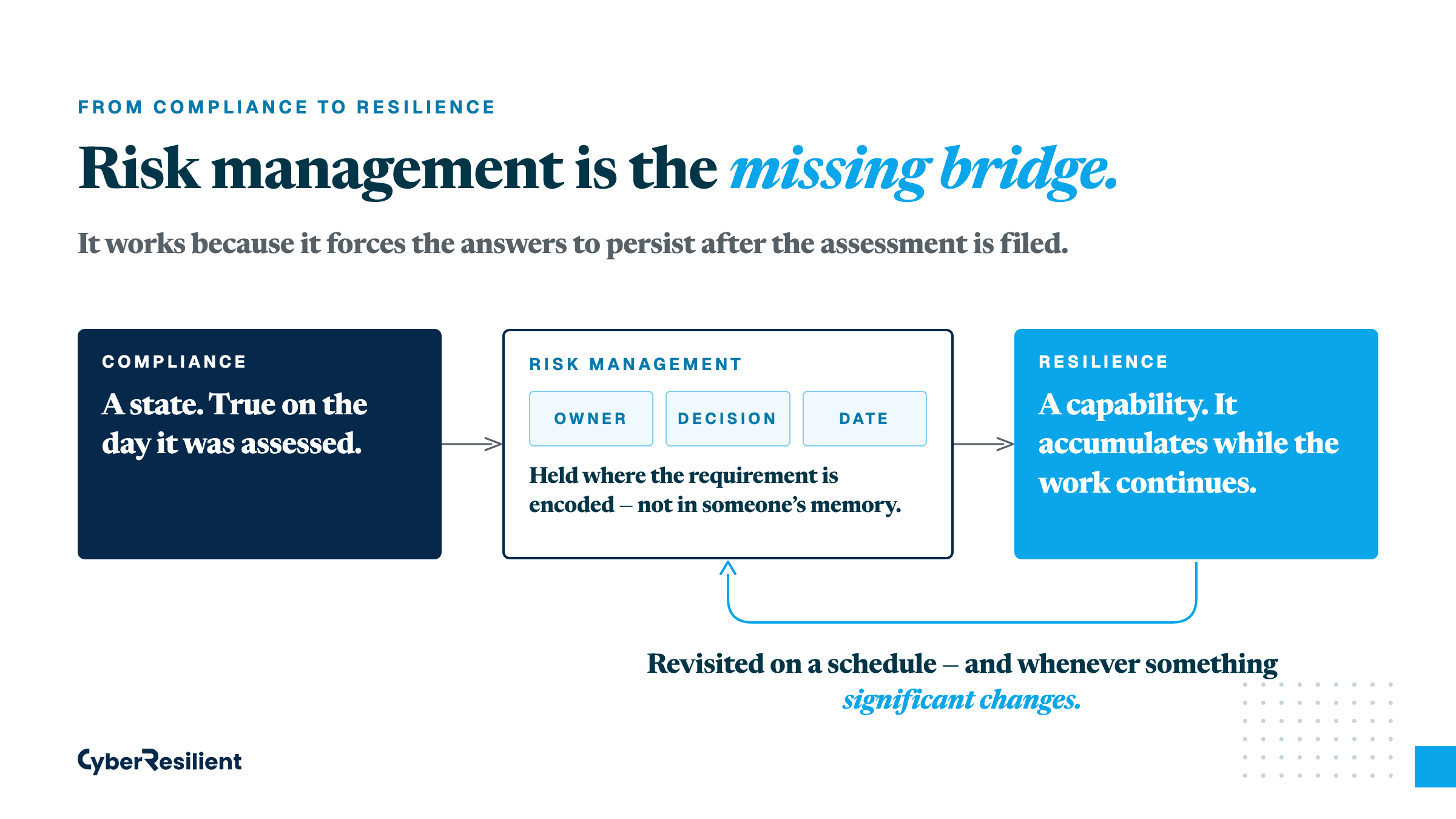
Risk management is the bridge between a compliance state and a resilience capability, and it works because it makes you answer those four questions and keep the answers after the assessor has left.
The most reliable way to keep those answers is to hold them in a system that prompts the next review rather than in someone’s memory, and to revisit them on a schedule.
Regulators are writing the same expectation into law. NIS2 holds management accountable for treating cybersecurity risk management as a continuing obligation, with planned reassessments and updates whenever significant changes occur. The Cyber Resilience Act requires manufacturers to handle vulnerabilities across a product’s whole support period, well past the launch certification. The scopes differ, but each assumes the obligation continues long after the assessor has left.
Meeting that bar means holding decisions, owners and dates in a form you can revisit and update, instead of chasing down the same data to rebuild a current view.
From compliance to resilience
Once findings have owners, decisions and dates, you can set priorities, and the exercise turns from backward looking to forward looking. The World Economic Forum’s 2026 Global Cybersecurity Outlook found 22% of organisations naming insufficient incident response and recovery planning among their top three barriers to resilience. The risk work has already ranked which processes matter most, so you know which to restore first after an incident, and you made that call before the crisis rather than during it.
Compliance shows that someone did the proper work at one point in time, while resilience is what accumulates when the work continues and the answers change as the organisation changes. With that record in place, you decide what happens next, even on the worst day.
What Control changes
That is the gap we built Control to bridge.
In Control, our risk management module, the answers live with the risk. A decision you made about a risk in March is still attached to it in September, with the person who made it, the date they set, and what has happened since. Because the record accumulates rather than resets, the reporting you pull from it shows how the picture has changed, in a form an auditor or a board can read without translation.
The questions the board should ask next
Most board conversations about security still orbit whether the organisation is compliant. It is a good question, but it tells you little about whether the organisation can cope with an incident.
Four better questions belong on the agenda for the next meeting:
- What are our most important cyber risks?
- Who owns them?
- What are we doing about them?
- Is our exposure increasing or decreasing?
These cover priority, accountability, action and direction. An organisation that can answer all four has moved from demonstrating a state to maintaining a capability.