Cyber Risk Management Without Enterprise GRC Complexity
Get cyber risk out of spreadsheets without an enterprise GRC programme: what Swedish rules require, and what to have in place.
- Risk management
- Compliance
- NIS2
- Board & governance
There is more than one way to manage cyber risks, but is buying an enterprise Governance, Risk, and Compliance (GRC) programme the right move for you? Maybe your risk register is a spreadsheet in several versions. Or perhaps you’ve been handed a GRC proposal with an implementation plan and planned workshops.
Whatever the case, the complexity of your organisation should decide whether you need a GRC platform.
Enterprise GRC solves a real problem for complex organisations
Gartner describes enterprise GRC tools as the most expensive tier and the best fit for large, complex organisations. Those organisations have:
- separate risk, legal, compliance and audit teams that need one shared platform
- risk and compliance specialists who monitor, and an internal audit function that gives independent assurance, both reading the same data, as the Three Lines Model sets out
- several risk modules and extensive customisation
In a mid-sized organisation, security and compliance often sit with one person or a small team. They need a current view of their risks, and they can build one without a GRC solution.
Complexity has a cost of its own
The complexity of implementing a tool like this requires a good deal of time and people resources. For organisations with an enterprise risk management department, Gartner found that choosing a GRC vendor takes more than six months in most cases, and reaching full use can take nine more.
It is difficult to find the people to manage these too, with 76% of organisations in ENISA’s NIS Investments 2025 survey reporting difficulty hiring cybersecurity staff. Each hour your team spends configuring a system is an hour it does not spend closing risks.
Mid-sized organisations still need proper governance
A mid-sized organisation has the same obligations as a large one. Under NIS2, Cybersäkerhetslagen and MCF’s regulations, MCFFS 2026:11, you need:
- management that approves the cyber risk measures, oversees them and gets a report at least once a year
- a named owner for each system and information process
- an action plan with a responsible role and a completion date for each measure
- a risk analysis you update when threats change or new vulnerabilities appear
The rules don’t prescribe a particular software, so if your setup will pass if it shows who owns each risk and gives management a report it can act on.
Everyone needs this workflow: understand, prioritise and act
Before choosing the tools, define your cybersecurity workflow.
- You need to understand your risks and prioritise them by consequence and likelihood.
- Then you can act through dated measures, follow up and go round again.
- Once you rank risks this way, you know where to put your budget.
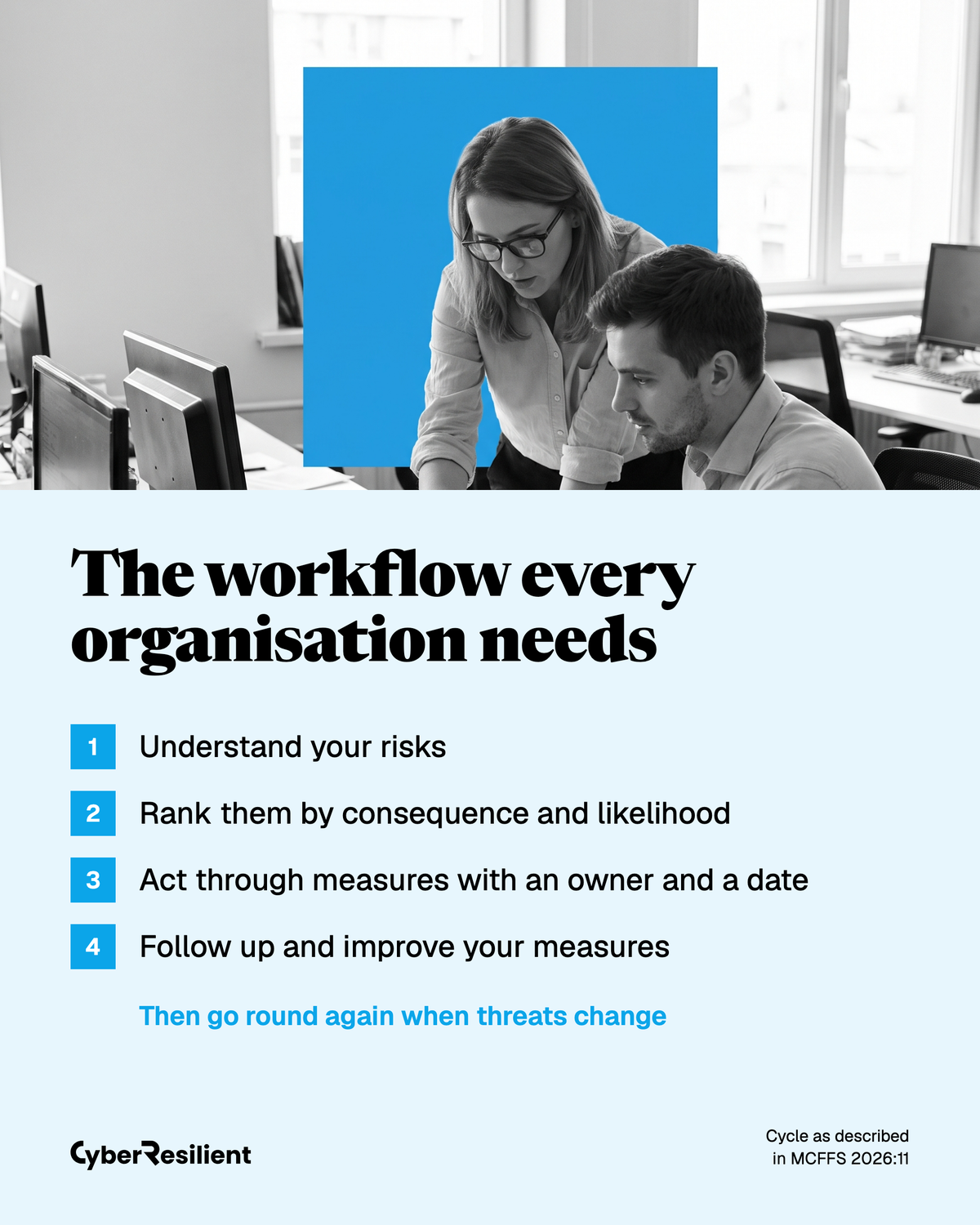
Many organisations have not full workflow even once. Among SMEs in ENISA’s survey, 63% did no cybersecurity assessment in the past year. If that includes you, consider a regular cadence your team can keep.
Give leadership a clear picture, and get more from your GRC
Leadership needs a clear picture of cyber risk. Management approves your measures, oversees them and gets a report at least once a year, and MCF requires the work to sit within the way your organisation already governs itself. Your workflow has to produce something a management meeting can read in minutes: which risks matter most, who owns them, what is overdue, and whether exposure is going up or down.
If your organisation already runs an enterprise GRC platform, adding a collaborative layer that facilitates a workflow of understanding, prioritisation and action makes it more valuable. Gartner found that about five functions, like IT and corporate compliance, share an enterprise risk management department’s main GRC tool. So how do you ensure the platform is current with data from each function? By giving them a continuous workflow with owners, deadlines, and a live status.
Where CyberResilient fits
We built CyberResilient because more organisations needed an accessible tool for this kind of workflow. It runs as a connected flow: you start with Visibility, free maturity assessments for multiple frameworks. Then findings are managed and resolved in Control, our risk management module. From there, the same data will move on into continuity and resilience.
The objective is faster risk ownership and action
The objective is to have an owner assigned and a dated measure on each risk as soon as you find it. You need enterprise GRC if separate risk, legal, compliance and audit teams have to share one platform. Whatever your size, you need these in place:
- a current view of where you stand against the frameworks you answer to
- a risk register where each risk traces back to the finding behind it
- an owner, a deadline and a status on every action
- a report management can act on, showing how the picture changes over time
With those four in place, cyber risk moves out of spreadsheets and email threads and becomes work with a name and a date on it, which you can run with or without an enterprise GRC platform.